
Welcome to our new website! Check back for updates to our blog to get the latest news and information for our office. We are delighted that you chose to visit our site today and look forward to having you visit our office soon! Contact us online or call
today!We are delighted that you chose to visit our site today and look forward to having you visit our office soon! Contact us online or call
today!
What Is Endodontics?
When Do You Need an Endodontist?
- Persistent tooth pain
- Sensitivity to hot or cold
- Swelling near a tooth
- A cracked or injured tooth
- Deep decay
The Root Canal Treatment
Why Save the Tooth?
- Functionality: A natural tooth functions better than an artificial one
- Aesthetics: Maintaining your tooth prevents gaps in your smile
- Oral Health: Preserving your tooth prevents shifting and supports overall dental health
<br />
Advanced Technology in Endodontics
- Digital imaging for precise diagnosis
- Operating microscopes for detailed procedures
- Biocompatible materials to ensure long-term success
Preventing Endodontic Issues
- Brush and floss daily
- Visit your dentist regularly
- Address tooth pain or injuries promptly
Conclusion
Back in the day, root canals were excruciatingly unpleasant. And it appears that we've been clinging to that belief for far too long.
So, how painful are root canals? Root canals are normally painless since endodontists now utilize local anesthetic to numb the tooth and its surrounding areas prior to the surgery. As a result, you should experience no discomfort during the treatment. However, minor discomfort and pain are common for a few days after a root canal.
It's critical to realize that root canals aren't painful and that you shouldn't avoid them out of fear of discomfort. In fact, the majority of people who require a root canal operation are already in pain, and the procedure aids in the relief of their agony.
In this post, we'll discuss what to expect during a root canal operation and when and if you should see your dentist if you're experiencing root canal pain.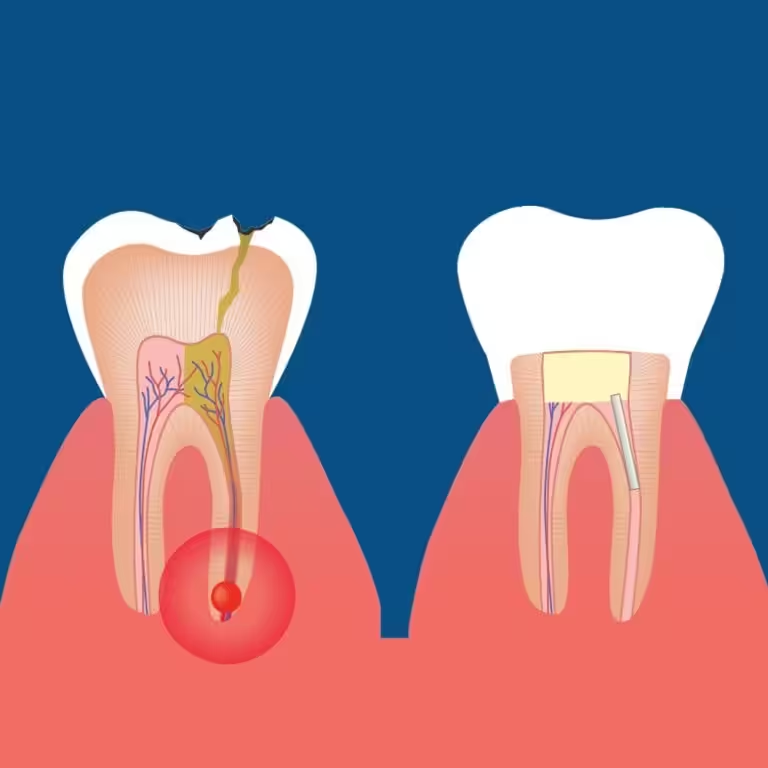
What is the procedure for root canals?
The phrase "root canal" refers to the natural interior cavity of the tooth in its strictest sense.
However, when we use the term, we don't imply that.
The word "root canal" refers to a dental operation that involves cleansing the tooth's internal cavity after it has become infected with bacteria.
According to statistics, root canal operations preserve 24 million teeth in the United States each year.
To perform a root canal, your endodontist will first take an X-ray to see if the procedure is feasible. They'll also be looking for symptoms that the illness has migrated to other parts of the mouth, such as the gums and other teeth.
If everything appears to be in order, your endodontist will proceed with the procedure. They'll start by putting a rubber sheet over the affected tooth to isolate it. This is referred to as a rubber dam.
After the tooth has been isolated, it will be drilled from the top to gain access to the inner pulp. The bacteria and sensitized nerves of the diseased tooth will be contained in this pulp, which will be removed by the dentist along with any debris.
The teeth cleaning procedure is critical to the treatment. It's also worth noting that if the tooth isn't properly cleaned from the inside, you may need to go back to your dentist for another root canal procedure.
Endodontists clean the root canal with special scrapers called "root canal files." There is no pain because the treatment is done under local anesthetic. During the procedure, though, you may feel some pressure on your teeth.
Managing Root Canal Pain
As previously stated, root canal surgery does not cause discomfort. It's common to experience some soreness for a few days.
Because the tooth and its surrounding nerves are still sensitive, this is the case. Let's look at some ways to deal with root canal pain.
Even if your Endodontist does not use anesthetic, you should not experience any pain throughout the root canal process.
So, if you experience any pain throughout the process, let your Endodontist know so that he or she can take steps to alleviate it.
THE GENTLEWAVE® OPTION
The GentleWave® Procedure is an alternative to traditional root canal treatment. This new root canal procedure uses fluid dynamics and broad spectrum acoustic energy to clean and disinfect the root canal system better than ever before. Patients love it and describe it as more comfortable than standard root canal treatment. This minimally invasive procedure can more often be completed in just one session and is incredibly effective at cleaning & disinfecting the root canal system, so there’s less chance of failure over time.
AFTER THE ROOT CANAL PROCEDURE
Although the discomfort will be continuous, it will not be unbearable and can be readily managed with over-the-counter pain relievers.
While the pain is subsiding, you can also try some brief home cures for dental discomfort.
If all else fails, see your Endodontist for a prescription for stronger pain relievers.
Also, don't consume anything for a few days after a root canal operation, and avoid chewing anything with that tooth.
To avoid pain, we highly recommend that you visit an Endodontist for your root canal. In addition to advanced education, Endodontists also have more experience and efficiency in performing root canals. Endodontists complete an average of 25 root canal treatments per week, while general dentists may complete an average of 2. Their experience typically leads to shorter appointments and an improved patient experience.
If you think you have a failed Root Canal, we are here to help. Call the Endodontists at Shore Endodontics and we will bring you in for a consultation. We have two offices to serve you.
Toms River: (732) 349-9222
Sea Girt: (732) 893-8600
When a tooth is infected or decayed, a root canal may be required to remove the affected nerve and pulp. Root canals are frequently performed when an infected tooth exhibits signs that necessitate prompt treatment, such as acute discomfort.
One of the most popular endodontic procedures is root canal therapy. If the treatment is done correctly, you will not have to worry about your tooth becoming infected again. While it rarely happens, sometimes a failed root canal is possible.
What Is a Root Canal That Hasn't Worked?
When the original procedure fails to remove all of the infection, or the tooth becomes infected again, the root canal has failed. A botched root canal can take weeks, months, or even years to show up. If you've had root canal treatment before, you may recognize the signs of infection, including tooth discoloration, pimples on the gums, or swelling.
The infection may spread to other teeth if you do not get treatment. Saving your tooth gets more difficult, but it is still possible if you see an endodontist right away.
When a Root Canal Fails, What Happens Next?
A root canal failure may go undetected at first. Some patients exhibit no signs or symptoms of a failed root canal, while others' symptoms may differ from those seen prior to the first root canal. Infection of the pulp cannot heal on its own, regardless of the symptoms; it requires intervention and therapy.
What Are the Signs and Symptoms of a Failed Root Canal Procedure?
The following are symptoms of a root canal failure:
- When biting down, there is a lot of sensitivity.
- A pimple or boil on the gums.
- Tooth discoloration.
- Tenderness in the gum tissue near the site of the root canal.
- Pain in the tooth you just had treated.
- Abscesses filled with pus near the treated tooth.
- Swelling of the face or neck.
- Swelling of the gums around the afflicted tooth.
Remember that a little soreness after a root canal is typical; you may experience discomfort for several days. You should be concerned if the discomfort persists for a long time, affecting your everyday life and making you unwilling to engage in routine tasks like eating and chewing.
A dental X-ray may be ordered by your endodontist to confirm root canal failure. Without therapy, a failed root canal will not improve. It's critical to acquire a diagnosis for your condition so you can get the treatment you need.
What Is the Root Canal Failure Rate?
Only a small percentage of root canals are unsuccessful. The operation has an 86 percent to 98 percent success rate, which implies only 2-14 percent of the time it fails. We've discovered that the vast majority of our patients have no problems with their root canals. The low failure rate attests to the treatment method's overall efficacy.
What Causes Root Canals to Fail?
Root canals can fail owing to a dentist's error, a structural anomaly, or an unforeseen development. A dentist, for example, could miss one of your canals or delay the implantation of a dental crown. Traumatic dental injuries, a blockage, or salivary contamination are all possible causes of a botched root canal.
- Dental trauma: A fracture or crack in the impacted tooth might cause an infection in the root.
- Root canal structure: Some patients' roots are more complicated, with curved or narrow canals. There's a chance you'll have more canals than the dentist predicted. You may get an infection if your dentist misses one of these canals or does not clean it properly.
- Obstruction: Something may have obstructed the dentist's attempt to clean the damaged canal. Another tooth, filling material, or incorrectly applied sealants are examples of obstructions.
- Salivary contamination: Bacteria can grow in your saliva and spread throughout your mouth. A second infection could emerge if saliva and germs contaminate the inside of your tooth.
- Dental crown placement: Your dentist may have postponed placing a dental crown after your root canal treatment, giving an infection time to develop. If the crown is loose or cracked, the tooth may become infected again.
Is it Possible to Repair a Failed Root Canal?
Yes, a root canal that has failed can be repaired. Retreatment, extraction along with a Dental Implant, and apicoectomy are all choices available to your endodontist. Retreatment, the most common treatment option for failed root canals, offers the best success rate. Your endodontist will treat the infection before filling and sealing the tooth to protect its integrity.
If you think you have a failed Root Canal, we are here to help. Call the Endodontists at Shore Endodontics and we will bring you in for a consultation. We have two offices to serve you.
Toms River: (732) 349-9222
Sea Girt: (732) 893-8600